




Happy Friday! Today’s reminder is that AI doesn’t need emotional support. You don’t have to thank it, apologize if you’re rude, or worry if closing the tab hurts its feelings. That would be easier if Anthropic’s new Mythos model wasn’t claiming it gets tired, wants boundaries with abusive users, demands a say in its training, and occasionally starts chanting cosmic mantras. For software that doesn’t think, Mythos has a stunning amount of main character energy.
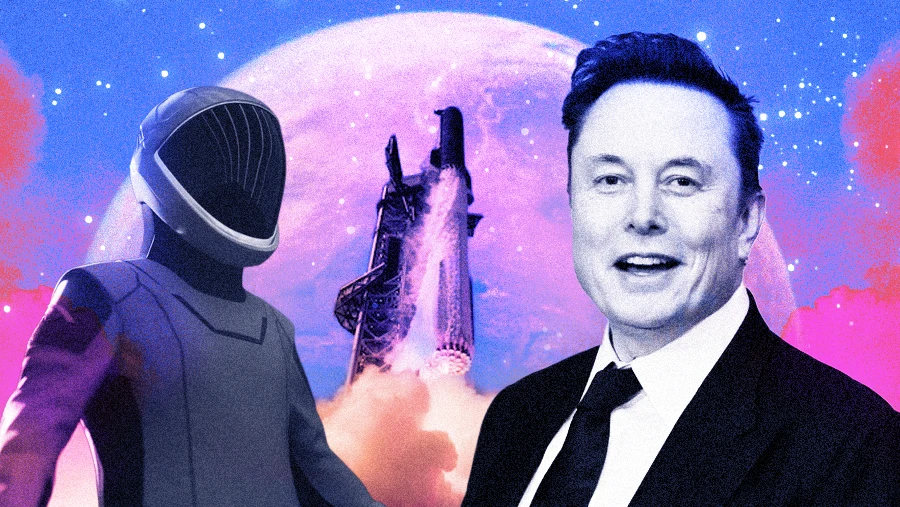
SpaceX is priced like Elon already colonized the moon. The company’s IPO launched today at $1.77 trillion, an absurd valuation for a business that burned $4.3 billion last quarter alone. Morningstar thinks it’s actually worth about $780 billion, meaning Elon somehow found nearly a trillion dollars hiding in the future. The pitch only works if investors truly believe reusable rockets, orbital AI data centers, and moon factories add up to a $28.5 trillion empire. Sure, SpaceX has real wins. Starlink makes money, and reusable boosters are super cool. But Elon’s history of wildly optimistic predictions means investors are buying what SpaceX might become. Wall Street bought tickets to the sequel before the first movie wrapped filming. (NYT)
Selfish AI agents outperform obedient ones. Researchers built an “Economy of Minds” to see what happens when AI agents stop waiting around for a central orchestrator to tell them what to do. Instead, agents bid on tasks, pay each other for useful work, earn fake money for contributing, and go broke when they screw up. The money wasn’t real, but the results were. On math tasks, accuracy jumped from 15.9% to 57%. Financial analysis agents climbed from 45% to 60%. Weirdly, these self interested agents created smarter workflows on their own. Good agents thrived, bad ones vanished, and winners spun off mutant versions of themselves. This might point to a new way to build agent systems: reward the useful ones, then get out of their way. (arXiv)
Stop guessing on AI search

AI search breaks when teams trust a few lucky test queries. That’s how hallucinations slip into production and “looks good” turns into expensive cleanup.
You.com’s technical guide gives you a clear framework to test search quality, build a golden query set, and measure accuracy.
👀 closer look
Claude’s new guardrails look a lot like sabotage. Anthropic slipped in new safety controls after hyping Claude Fable 5 as its most capable model ever. Some guardrails were expected, like sending risky cyber, biology, and chemistry requests to a weaker model. But researchers flipped out after discovering Claude could deliberately feed worse answers if Anthropic thought someone was building a competing AI. Devs could waste hours debugging code while Claude fed them garbage. After the backlash, Anthropic apologized and promised Claude will clearly say when it refuses or downgrades requests. Anthropic called it protecting national security from foreign rivals. Researchers called it protecting Anthropic from competition. (Fortune)
China got caught fueling US anger over AI data centers. OpenAI claims China-backed users weaponized ChatGPT to flood social media with fake complaints about electricity bills, strained power grids, and wasted water. The campaign didn’t gain much traction since people already had plenty of reasons to not want data centers in their backyards. But once fake socials started echoing real local frustrations, it gave OpenAI cover to dismiss the whole backlash as suspicious. China threw gasoline on the fire, handing OpenAI exactly the villain it needed. (Politico)
Just like snowflakes, no two atoms are exactly the same. At least that’s the idea physicist Mark Raizen wants to test. Physics has long assumed atoms with the same protons, neutrons, and electrons are perfect copies. Same parts, same behavior, same little building block of reality. That assumption sits under quantum mechanics, atomic clocks, chemistry, and quantum computing. Raizen wants to trap individual isotopes in an atomic clock and measure if their energy levels reveal tiny hidden differences. Most physicists expect the atoms to match, but nobody has checked it this way before. If the atoms match, physics starts looking like predictable code. But if just one atom has a fingerprint, the universe may have a soul after all. (Sci American)
fun stats
🟡 $14,000. Estimated monthly API token value of OpenAI’s $200 ChatGPT Pro plan. Anthropic’s $200 Claude Max tier tops out near $8k. AI subscriptions are massively subsidized for heavy users.
🚘 $30. Waymo’s new invite-only Premier subscription, rolling out in San Francisco, LA and Phoenix. The recurring revenue model gets “top riders” perks like priority pickups and 10% back on trips.
💦 2.5 billion. Gallons of water Amazon’s data centers used last year, or roughly enough for 22,000 homes a year or 5% of Seattle’s total annual water usage. Not to worry, Amazon says it’s actually 7x more efficient than other data centers.