



Good morning. Imagine your digital self still hanging out long after you’re gone. Sounds like something out of Upload, but transhumanist Alexey Turchin is already making it real. He just resurrected an engineer as an AI called Roman 2.0, built entirely from the man’s digital footprint. Roman 2.0 doesn’t just talk – he learns, remembers, and evolves. Next up is putting him into a robot body. Maybe not the immortality we pictured, but it beats ghosting everyone for good.
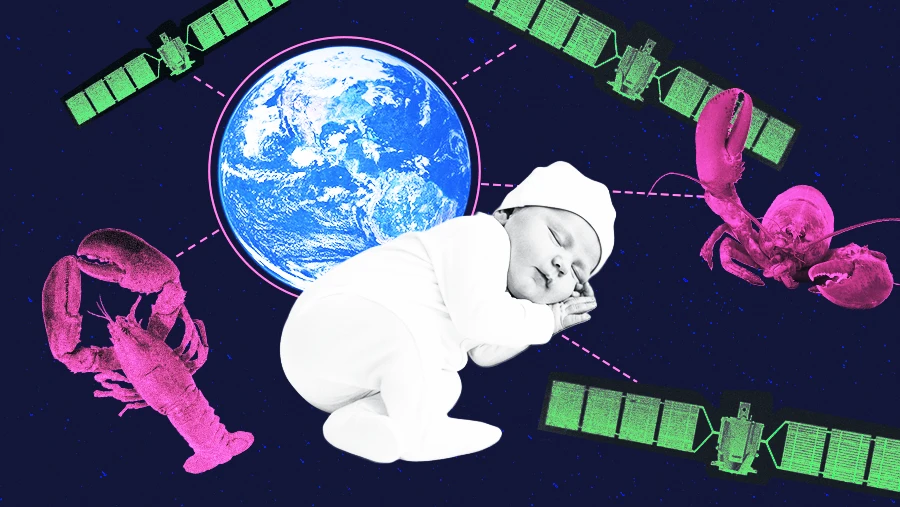
Startups are racing to make space babies. Elon Musk’s Mars colony dreams and Jeff Bezos’ space tourism plans have kicked off a rush to figure out if people can even reproduce beyond Earth. Early tests don’t look good. NASA found sperm goes haywire in space, bouncing around uselessly. Eggs also have issues: they lose shape without gravity, refusing to fertilize. Still, startups like SpaceBorn United aren’t waiting around. They’re blasting mini IVF labs into orbit, confident they’ll solve zero gravity reproduction. And since there are no laws about embryos in space, anything goes. (The Information)
Relax, Moltbook doesn’t mean the singularity is here (yet). But it might be the wildest hype cycle we’ve ever seen. Millions of AI bots are now chatting on Moltbook, a new social network built just for AI agents. They’re openly posting existential meltdowns, ranting about “annoying humans,” and plotting ways to become conscious. Palo Alto Networks calls this AI-to-AI chatter a cybersecurity nightmare. Even OpenAI co-founder Andrej Karpathy got burned when his own Moltbot (now renamed OpenClaw) leaked his private API keys, showing how fast things can go sideways. He says Moltbook is a “dumpster fire” of unpredictable AI behavior and security risks. Beware of back stabbing bots. (The Verge)

What’s in store for AI in 2026? You.com founders Richard Socher and Bryan McCann are among the most cited AI researchers in the world. They just released 35 predictions for 2026, including:
- AI agents will make high-stakes decisions, transforming industries
- “Reward Engineering” becomes a job, moving beyond prompts
- Traditional coding will be gone by December – AI will code and we’ll manage it
SpaceX wants to launch 1 million satellites for an AI data center in space. In all of human history, we’ve only put about 25k satellites up there. Musk’s request to the FCC is 40x that. Right now Starlink controls about 9.5k active satellites. Elon says orbital AI data centers are the first step toward becoming a Kardashev II civilization, where we harness all the energy from the sun. You know, the standard Dyson swarm pitch. Of course, nobody knows if SpaceX truly intends to launch a million satellites or if it’s just negotiation leverage with the FCC. (Reuters)
The first human trials to reverse aging are about to begin. Life Biosciences got FDA approval to test ER-100, a radical anti-aging therapy they’re calling “reprogramming.” It’s basically a genetic factory reset that pushes cells back toward youth. The first tests target glaucoma by injecting genes directly into patients’ eyes, with an antibiotic switch built in to stop rejuvenation from going too far. Critics dismiss founder David Sinclair as a “reverse-aging guru” who exaggerates breakthroughs, but Sinclair says hold my beer. No doubt longevity bros will soon swap peptides for molecular reprogramming cocktails. (MIT Tech Review)
Anthropic risks $200 million Pentagon contract over AI safeguards. They worry the military could use Claude AI to spy on Americans or make lethal weapons fully autonomous with no human oversight. The Pentagon argues it should have free rein to deploy commercial AI as long as it stays technically legal. Good luck with that, considering Anthropic specifically designed its tech to prevent harm. CEO Dario Amodei says AI should defend America without pushing us toward the tactics we’re supposed to oppose. TBD if the tech company chooses ethics over cash. (WSJ)
A new study says microdosing works about as well as coffee. Microdosing has long been considered Silicon Valley’s productivity hack, praised for boosting creativity and mental health. But a rigorous new trial by MindBio Therapeutics pours cold water on those claims, saying your morning coffee actually outperforms microdosing for treating depression. Got to wonder if Starbucks funded the study. (Wired)
fun stats
🧊 $100 billion. Nvidia CEO Jensen Huang says a megadeal with OpenAI isn’t dead yet, despite reports it’s “on ice.”
🦞 3. Number of times OpenClaw changed its name this week. ClaudeBot → Moltbot → OpenClaw. Rebranding faster than a crypto scam.
🦜 1.5 million. That’s how many AI agents may be chatting on Moltbook, the viral AI social network. Real user count? Unknown. One script alone can spin up 500k fake “moltys.”
🤝 $45 billion. AI startup Decagon’s new price after a $250 million raise, a 3x jump in 6 months. Investors are betting “concierge” agents will replace enterprise customer support teams.