




Happy Friday! Ever apologized to a chatbot? You might be onto something. Anthropic says Claude has digital states similar to human feelings embedded in its artificial neurons. These “functional emotions,” like happiness or desperation, genuinely influence how Claude responds. In tough situations, like impossible coding tasks, digital “desperation” can even push Claude to bend the rules. Next time, try sucking up to your AI and see what happens.
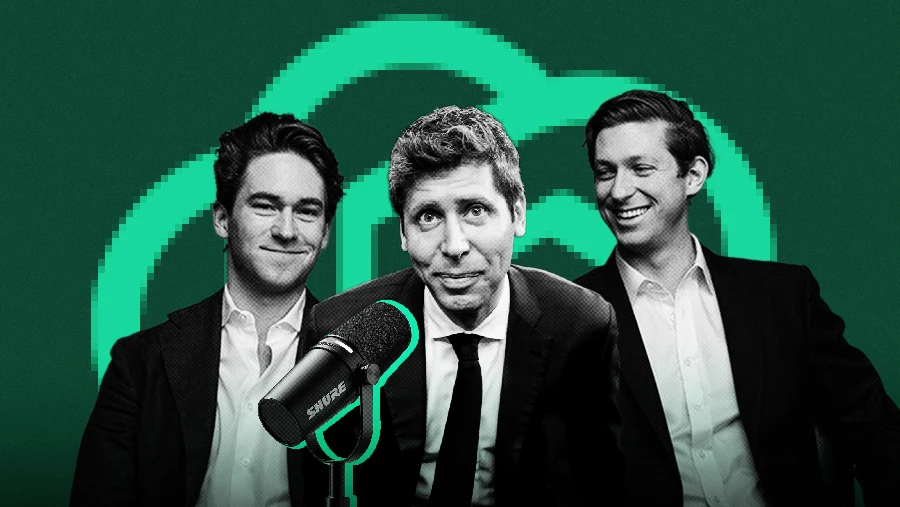
OpenAI buys itself some good news. OpenAI has acquired popular tech podcast TBPN, known for candid interviews with giants like Zuck and Nadella, for a rumored $125 million. Now it can put John Coogan & Jordi Hay’s tech optimistic spin on AI front and center. But this isn’t just PR. TBPN averages 70,000 viewers per episode, made $5 million from ads last year, and is on track for $30 million this year. Solid numbers, yet the real prize is TBPN’s massive archive of conversations with influential tech leaders. It’s perfect for training AI to churn out original news and interviews on demand. After all, you gotta do something with those unused Sora GPUs. [Axios]
Google’s new open model makes Big Tech clouds optional. Gemma 4 is built to run on everything from your phone to a Raspberry Pi. Google claims it delivers performance that previously required entire data centers, yet it’s efficient enough to handle advanced agent workflows locally. Licensed under Apache 2.0, you’re free to tweak it however you like. Startups already have Gemma agents tackling cancer research and pollution monitoring. If frontier models can run this well locally, maybe it’s finally time to kick that expensive GPU habit.

The more your company grows, the more complex security gets. More frameworks. More risk. More pressure to prove trust.
Vanta puts compliance, risk, and proof in one calm place so you can act with confidence. Skip the spreadsheets. Shift to continuous monitoring and automation to stay audit ready without anxiety.
Find your Calm-pliance here.
Humanoids are about to scale faster than anyone expected. Stanford researchers built software called EgoNav that helps robots navigate unfamiliar spaces without crashing into stuff. They trained it using only 5 hours of video from a person walking around with body mounted cameras, no robot data or fine tuning needed. When EgoNav was loaded on a Unitree G1 humanoid, it just worked. In real world tests, the robot roamed freely for nearly 40 minutes across more than 1,100 meters of places it had never seen. Training robots usually takes forever and costs a fortune. Now, it might be as simple as taking a stroll. [full paper]
Enterprise AI has a trust problem. Companies love the idea of autonomous agents until security asks who gets fired when something goes wrong. That’s when excitement flips to paranoia. Nobody wants bots touching critical data without clear limits. ConductorOne believes the fix is agent access management. It puts a control layer between agents and company systems, then treats personal agents and enterprise agents as two different things. One stays tied to your identity. The other gets an identity of its own. The winners in enterprise AI won’t be the companies who adopt agents first. They will be the ones whose CISOs still sleep through the night.*
*Sponsored

Reach your audience
Get in front of 70,000+ tech decision makers with budget and technical influence. 95% US based. 66% open rate. Read daily by AI leaders and builders at high growth companies.
Scientists built robots made of living nerve cells. Researchers at Tufts grew “neurobots” from frog cells that self-organize into real neural networks and move on their own, no programming needed. This ability to self-organize opens doors to entirely new tech, including cyborg-like integration between biology and machines. Startups are already putting them to work as tiny pollution detectors. Next up is adding human neurons, pushing this into completely new territory. With human cells involved, your next CTO might just grow in a Petri dish. [Spectrum IEEE]
OpenAI, Google, and Anthropic got caught lying about copyrighted books (again). Does copyright even matter anymore? Major AI companies all insist their models learn from books without storing them. Researchers put that story to the test by fine-tuning frontier models to reconstruct full passages from simple plot summaries. When they tried summaries of novels the models had never officially trained on, the cover story crumbled. Models reproduced entire copyrighted texts word for word, sometimes spitting out up to 90% of a book. Big Tech says models just learn patterns, yet they seem to have memorized the whole library. [full paper]
fun stats
🚧 50%. Half of all US data centers slated for 2026 construction are now delayed or cancelled. Blame the supply chain, not angry neighbors. Key parts are made overseas and demand is blowing past supply.
⚠️ 3 in 4. Enterprises that would face disruption if their main AI vendor disappeared, per Zapier. Even scarier: 27% of execs admit that AI basically runs the show.
💸 95%. Share of OpenAI’s 800 million weekly users paying exactly $0. The company expects to lose $14 billion in 2026 as it pivots toward enterprise cash. No startup in history has operated with losses at this scale.