





Good morning. If you ask AI for a story, there’s a decent chance a man named Elias Thorne will wander in, wearing a dramatic coat and carrying a secret. He shows up as a lighthouse keeper, clockmaker, detective, or whatever else the chatbot needs him to be that day. Researchers found Elias popping up in 27% of 20,000 AI generated stories across four different models. Now his name is appearing in books and videos across the internet. This may be one of the cleanest examples of model collapse where AI invents the myth, the internet publishes it, and the next AI treats it like culture.
AI coding agents taught themselves how to control robots. Nvidia researchers gave the agents access to a fleet of real robot arms, then let them write the training code themselves. The AI agents tested that code on physical robots, watched what failed, rewrote the code, and kept going without people babysitting the process. The robots learned real work like installing GPUs and hit a 99% success rate across four physical tasks. Scaling from one robot to eight cut training time by more than half. The big leap is that AI self improvement just moved from software into the physical world. Robot training is shifting from people teaching machines to software teaching hardware how to move. (Nvidia, Decrypt)
Ghost agents are the new insider threat. Companies are rolling out AI agents that log into systems, run workflows, and make changes using their own credentials. IAM maps the agent to an employee, and everyone assumes the identity problem is solved. But when the owner moves on or the project ends, the person gets offboarded, while the agent keeps working because its account still looks valid. One finance agent reportedly kept reconciling accounts months after its creator left. Security teams call these non- human identities, but they’re really zombie accounts with enough access to touch sensitive data or spend company money long after everyone’s forgotten them. Giving agents permissions is easy. Companies still haven’t figured out how to take them away. (Forbes)
Run open-source LLMs in real production
Capture live traffic, fine-tune and optimize, then deploy your own checkpoints to dedicated GPU endpoints.
Choose hardware, set scaling limits, and select region. Stable latency, predictable cost, clear data residency.
👀 closer look
Claude Agent SDK just escaped usage-based pricing… for now. Anthropic planned to move agent users onto API rates on Monday, forcing heavy Claude users to pay by the token instead of leaning on their normal subscriptions. Developers had been running Claude agents through coding tools, third party apps, and the command line like an all-you-can-compute buffet. The change would have turned every coding job into a much bigger bill. Then Anthropic blinked at the last second and “paused” things. The meter is still coming. It just got delayed. (ArsTechnica)
The hottest job in China is pretending to be a robot. In Shenzhen, workers are wearing VR rigs to control humanoid robots remotely. A startup called IO-AI Tech is building software that transfers a person’s movements directly into different robot bodies. The robots are training for blue-collar work like stocking shelves and folding clothes, generating motion data with every shift. A local sewing equipment company is using the tech to train robots to iron shirts right on existing production lines. This is the part everyone should watch, because China has the hardware supply chain close enough to turn physical AI into factory routine. Workers wear headsets, robots learn the job, and the factory moves one step closer to running without people. (Wired)
🏖️ THE SANDBOX
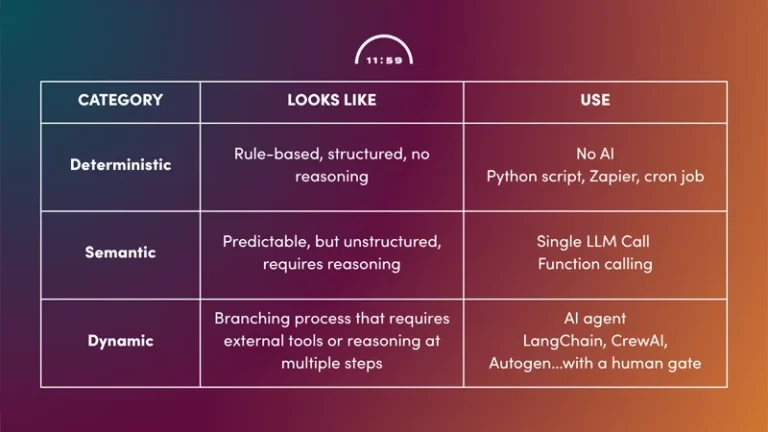
What you’ll learn: Most workflows don’t need an agent. In this guide, you’ll learn how to spot the difference between a simple automation, a single AI call, and a full agent so you always pick the right tool for the job.
Step-by-step:
- Choose the workflow you want to automate. Pick something clearly repetitive or painful, like email routing, customer support triage, vendor reviews, or document processing.
- Write down every step in plain language, exactly how someone does it today. Include inputs, outputs, decisions, and tools. Don’t skip the hidden steps that live in someone’s head.
- Categorize each step simply: Deterministic means automation, no AI needed; Semantic means some AI plus automation; Dynamic means a full agent – complex workflows with branching logic, external tools, or judgment calls.
- Start with the easiest or highest ROI step first. Score an early win, build momentum, and then tackle harder parts once your team trusts the process.
Pro tip: Agents are the only automation that can keep making decisions and taking actions on their own. That’s useful, but it also makes them slower, more expensive, and less predictable than automations or single AI calls.
Need help building agents or automations for your team? 11:59 can help.
fun stats
📱 $1,299. Rumored price of the iPhone 18 Pro as memory chip costs climb. Coincidentally, that’s also the price of Snap’s new AR glasses that are getting roasted by everyone.
😩 16%. Americans who believe AI will have a positive impact on society, according to Pew. The vast majority are not optimistic.
🙋♂️ 50%. One time stock tax Bernie Sanders wants on AI companies with $200 million in annual sales. His plan would give Americans a stake in the AI boom.