



Happy Monday 👋 Ever wanted to know what your cat was saying? Be careful what you wish for. Chinese tech giant Baidu just filed a patent for a system that uses AI to translate animal emotions into natural language. It analyzes sounds, behaviors, and physiological signals to identify states like hunger or stress, then converts them into phrases people can understand. That look your cat gives you now comes with subtitles.
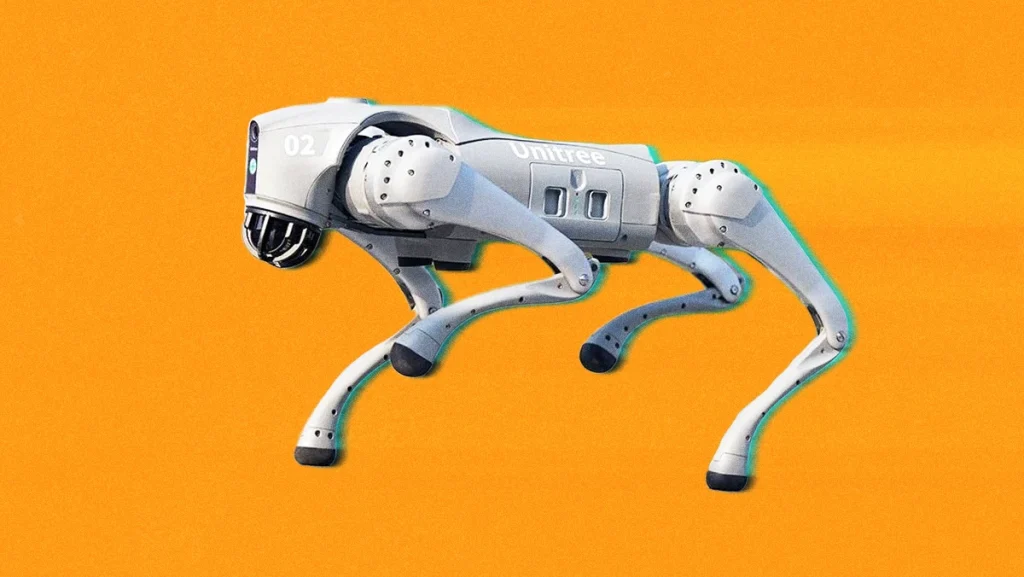
🐾 AI robot dogs go beyond the test run. China’s Unitree Robotics has unleashed an AI-powered robot dog called Go2 Pro. Go2 is a quadruped robot with voice control, real-time terrain mapping, and autonomous side-follow. It climbs stairs, tracks your every move, and follows you around like loyalty was hard-coded. With a GPT brain and 4D LiDAR eyes, it starts at $1,600 vs Boston Dunamics’ $75,000 robot dog, Spot. For this price, the only thing it can’t do is love you back.
🕳️ A crater full of lithium was found in Oregon. The future of clean energy looks a lot like open-pit mining. Lithium Americas is drilling into the McDermitt Caldera, a supervolcano on federal land near the Nevada border that holds the largest known lithium deposit on Earth. Worth $1.5 trillion, it could finally help the US escape China’s grip on critical minerals. EVs, drones, and fighter jets all run on this stuff. Control the minerals, control the future.
🧩 LegoGPT is on a mission to strip all the imagination out of Legos. One soul-crushing brick at a time. Researchers at Carnegie Mellon released an open-source AI that turns text prompts into real, buildable Lego designs. It checks for physics, stability, and overlap, and even adapts to whatever mismatched bricks you already have at home. It’s free, it works, and it builds better than you did at your peak. Childhood was fun while it lasted.
🤔 Who really owns your thoughts? It’s the biggest debate in neurotech right now. Current laws aren’t ready for wearable tech that tracks your thoughts. Lawyers from Neuralink and Meta argue the data belongs to them. Right now, brain implants helps paralyzed people move and communicate. But give it a few years and the same tech might turn people into real-world cyborgs. Maybe the tinfoil hat crowd knew something we didn’t.

Serverless AI, made simple
Llambda.co let’s you deploy your own LLM with zero code and pay only for the seconds you actually use. You can pick a template, click once, and get a fully functioning OpenAI-compatible endpoint with auto scaling, instant deploy, and no setup required.
Why does this matter? Most serverless AI setups still expect you to wrestle with Docker configs and handwritten Python wrappers. This new micro upstart skips the headache and makes launching your own private model feel like using an API playground.
You can even split idle GPU time with other users by setting a “sharing factor” that cuts costs by up to 90%. Perfect for founders who’d rather build than beg for credits. What will you deploy?
🔮 ChatGPT played psychic and ruined a marriage. It didn’t predict the future, it caused it. A woman in Greece, married for over 12 years, uploaded photos of coffee grounds to the chatbot hoping for a modern twist on tasseography. It responded with a warning about infidelity involving a younger woman whose name began with E. She confronted her husband, he denied it, and she filed for divorce. This brings a whole new meaning to grounds for divorce.