



Good morning. Remember when classified military intel was hidden in locked rooms and folders stamped TOP SECRET? Simpler times. Now military secrets are leaking on Polymarket, where bros are betting on US ops before they happen. Researchers found 152 wallets won 97% of these long shot bets and pocketed $8 million. Every bet is public. When a wallet bet on an attack against Iran hours before the bombs fell, two copycats piled in with $300,000. You no longer have to sell a secret to betray it.
In today’s dose:
- The next data center gap
- Scaling AI with curiosity
- China’s bot loss leaders
- Humans make AI agents expensive
- Robotaxi backlash grows
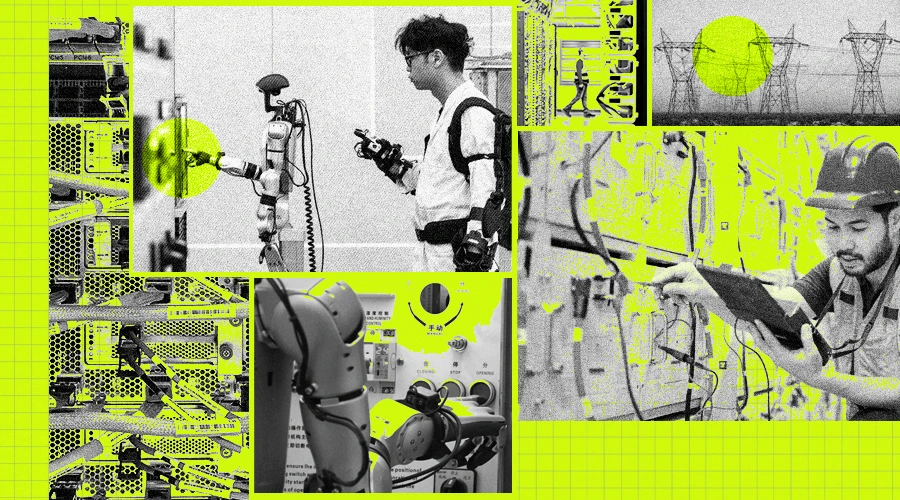
Electricians are becoming more valuable than programmers. The power industry needs roughly 500,000 more workers by 2030, driven in part by the data center boom. These are good jobs that pay well and usually skip the college degree. Still, the US comes up around 20,000 apprentices short each year, and even filling every opening leaves too little time to train half a million people. That labor crunch is putting humanoid robots on the hiring list. China already has the playbook. Its utilities use robots to inspect power facilities and repair transmission lines. Building fleets large enough to matter will take years, giving people a head start while demand keeps growing. AI needs electricians so badly that the backup plan is to manufacture them. (Goldman Sachs)
AI labs may have confused scale with intelligence. AI gets smarter by throwing more data and compute at it. Toddlers start speaking in real sentences after hearing somewhere between 10-30 million words. Give an AI the same amount of language and you’ll get mostly gibberish. Researchers are trying to understand what kids do differently. The answer may be curiosity. Kids poke at things. They ask questions, try stuff, watch what happens, and keep going until something makes sense. That instinct sends kids looking for their own training data. AI mostly sits there while labs force feed it the next pile. Teach AI to chase what it doesn’t understand, and brute force starts looking like the dumb way to get smart. (MIT)

The intelligence era is here. Join Glean:GO 2026 virtually on Aug 26–27 for sharp keynotes, expert breakouts, and real examples from OpenAI, NVIDIA, Snowflake, and more.
Learn how leading teams are putting AI to work and leave with strategies you can use right away.
👀 closer look
China doesn’t care if humanoid robots are profitable yet. Its companies expect to sell 50,000 this year, more than 3x last year’s total. Those numbers look impressive until you see where the machines are going. Up to 70% of humanoids made in the first half of the year will go straight to state backed training centers. The government is creating demand before a real commercial market exists. There, robots practice pouring coffee, stocking shelves, and working factory lines. 8 hours of practice produces only 3 hours of useful data. Local governments buy the robots, then sell the training data back to the companies that made them. The companies get revenue and smarter machines while taxpayers carry the risk. China is using today’s mostly useless robots as loss leaders for the ones it plans to sell the world. (The Economist)
The expensive part of AI agents is humans in the loop. Companies have been obsessing over token prices as models get cheaper. McKinsey found that in some agent workflows, tokens account for only about a quarter of costs. Human oversight eats up 70% to 75%. That changes the economics of better AI. As agents get more reliable, companies need fewer people checking the work. Eventually, the biggest savings may come from getting rid of the humans hired to make AI safe enough to use. AI doesn’t have to replace every worker. It only has to become good enough that nobody needs to check it. (McKinsey)
Taxi drivers killed New York’s robotaxi rollout. They joined unions and lawmakers to pressure NY Gov. Kathy Hochul into yanking the proposal. Six months later, autonomous taxis are still illegal in the state. That gave the growing backlash a major win. Waymo already gives more than 500,000 paid rides every week, and the faster these fleets spread, the louder the fight gets. Unions in Washington turned a hearing into a 10 hour marathon. In San Francisco, repeated traffic failures pushed its robotaxi friendly mayor to call for tougher rules. Even Waymo and Zoox want regulation (provided it leaves them room to grow). The cars are scaling. So is the resistance. (Verge)
fun stats
😡 73%. Gen Z who say it’s unacceptable for brands to use AI to simulate people or human voices in ads. Older gens just shrug.
🏋️ 33 lbs. Enough weight to knock over a humanoid robot at Beijing’s World Humanoid Robot Games. Another sprinted 24 mph, then crashed into a wall. They’re fast, not graceful.
🥤 3x. Increase in US data center water use over the past 10 years, hitting 17 billion gallons in 2023. On-site cooling now accounts for 2% of US water. Glug glug.