





Good morning. Your DNA already carries enough info to build another you. A single gram can hold 215 million gigabytes of data, so Penn State researchers wondered if it could handle other files too. They added silver to synthetic DNA so it could carry electricity, then paired it with a material used in solar cells. The result can store and process info at the same time like neurons in your brain do. That should leave plenty of room in the cyborg future for your vacation pics.
In today’s dose:
- AI engineer passes certification
- Fuzzy AI company math
- Can a Mac replace your $200/month AI bill?
- Websites can ID you with sound
- Patients want a say in medical AI
An AI agent designed a wind turbine good enough to get certified. Researchers put a system called ‘The AI Engineer’ to work on the floating platform that keeps a 20 megawatt offshore turbine upright. The agent drew a structure, tested how well it handled wind and waves, then revised the design whenever the physics exposed a problem. That loop let the AI explore thousands of ideas before choosing the strongest one. The final design used 8% less steel and cut costs by over $200k compared with a version that took a team of 200 people two years to develop. It then survived three rounds of questions from outside engineers before the design was certified. It’s happening. The machines are starting to design better machines. (arXiv)
AI companies have no idea if they’re making money. SaaS used to have clean math. Companies knew what customers paid and roughly what it cost to serve them. AI wrecked that model. A single product can trigger millions of API calls across multiple models whose prices often change. Keeping track is a mess. The work gets sold before the final compute bill arrives, and usage dashboards don’t always match the invoice. Companies know the revenue from each customer, but not always the AI cost behind it. That means some may be selling AI products at a loss without realizing it. Payment firms are racing to build a better meter that tracks what every task really costs. (The Information)
Everyone wants to put AI in front of customers. Very few can make it accurate enough to trust.
Cube is the agentic analytics platform built on a semantic layer, so AI agents answer from trusted metrics instead of guessing. Brex built an AI financial analyst for 35,000+ customers on Cube and lifted answer accuracy from the high 50s to nearly 90%.
Get started now and see agentic analytics on your data.
👀 closer look
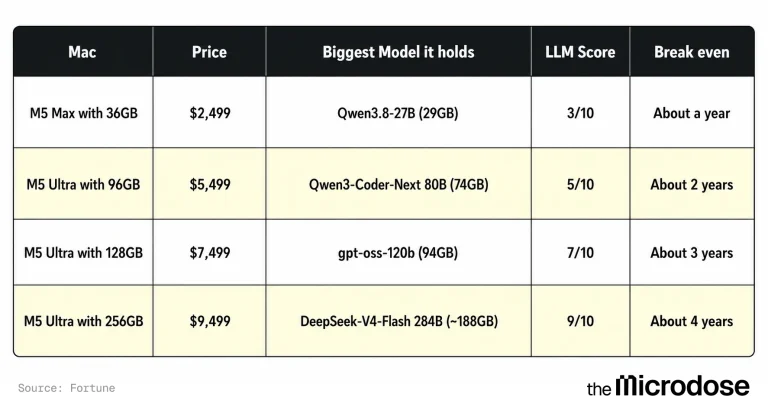
Can Apple’s new Mac Studio replace your Claude or ChatGPT subscription? Apple wants to move AI from the cloud onto your desk, giving you unlimited use while keeping your data private. Against a $200 monthly AI coding bill, the Macs take about 1–4 years to pay for themselves. The base 36GB model is useful for routine work. At 96GB, you get a capable coding agent, but it still trails Claude. Qwen3 Coder Next scored 31% on the same benchmark where Claude Opus 4.5 hit 54%. Jump to 128GB and local models become strong enough for serious daily work. At 256GB, they get close to frontier quality. Apple also made prompt processing up to 4x faster, which matters when agents keep rereading your files and past work. The catch is model size. Kimi K3 recently topped a major web development leaderboard but needs about 1.4TB of memory. Even Apple’s upcoming 512GB Mac Studio can’t hold it. Local AI works if models keep getting smarter and smaller. (Forbes)
Websites can ID you with sound. A researcher stumbled across the trick when music from his phone kept cutting out through his Bluetooth headphones every time he opened AliExpress. He dug in and found two hidden scripts creating a sound people can’t hear, then measuring how his browser handled it. That response became part of a larger fingerprint built from things like graphics hardware, screen size, memory, and mouse movement. Put enough clues together and a website can recognize you even after the cookies are gone. It can spot AI agents too. Go ahead and reject the cookies. Your browser already sang your name. (Ars Technica)
Should patients have a say before their doctor uses AI? Nearly half of Americans have no idea if AI has ever played a role in their own care. Doctors use it to analyze scans, help diagnose problems, explain lab results, and take notes during appointments. AI can shape a medical decision while the patient assumes it came from the doctor alone. Pew found 81% of patients want to know when AI is involved. Most also want more control over whether doctors use it at all. Right now, many feel they barely have any. AI gets a say in your diagnosis before you get a say in AI. (Pew Research)
fun stats
🗽 #1. NYC just stole San Francisco’s crown as America’s biggest tech talent hub. New York’s tech scene added 30,000 jobs while the Bay Area shed 6%.
🥞 10 mins. Skild AI’s S1 robot can supposedly learn a brand new task this long from a single video prompt, with no fine tuning. Who knew robotics’ ChatGPT moment would involve pancakes and coffee?
🌶️ 4.1x. Performance boost Jalapeño delivers on interactive AI workloads. OpenAI’s first custom chip is coming for Nvidia.