



Good morning. How far can you push conversational AI in the real world? One engineer built Rachel, an AI agent with a friendly Northern Irish accent, to find out. She spent a weekend chatting up bartenders across Ireland to ask about the price of a pint of Guinness. Over 1,000 pubs shared their prices, creating the country’s first crowdsourced Guinness price map in 14 years. Bartenders never suspected Rachel wasn’t human, but pub owners noticed when local price wars suddenly broke out.
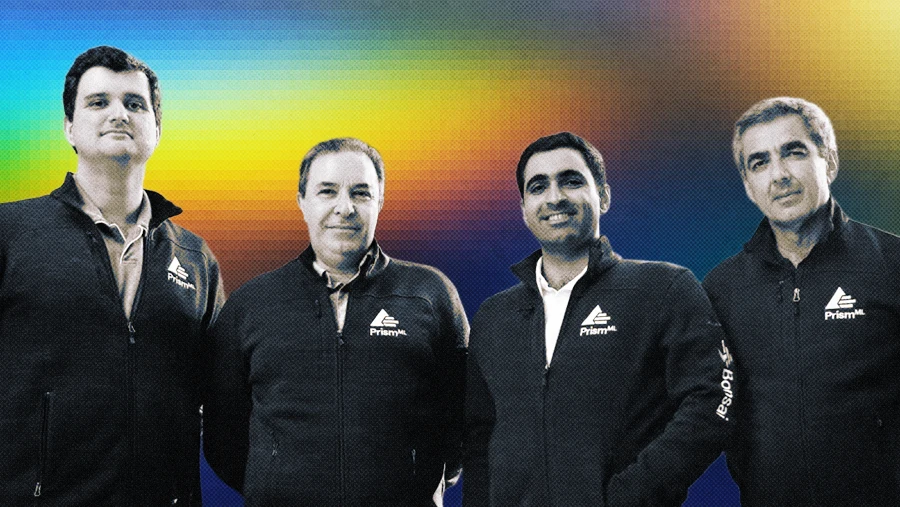
Whoever delivers the most intelligence per unit of energy wins. A Caltech spinout called PrismML just emerged from stealth claiming it can compress AI models from 16 bits to just 1 bit without killing performance. If they’re right, frontier models could soon run directly on phones and wearables. Their open source “Bonsai 8B” model is reportedly as powerful as current large models but uses 8x less memory and cuts energy use by up to 80%. This completely flips token economics upside down. Last week Google’s TurboQuant release caused ram prices to crash. Could PrismML make trillion dollar data centers suddenly obsolete? [WSJ]
Is the secret to smarter AI just internal “voices” arguing? Google’s dropped a paper suggesting the next big leap in AI might not come from building one giant brain, but from models that improve by debating themselves. Researchers say top AI models solve tough problems by generating multiple competing perspectives within their own reasoning. They argue this internal back and forth may be key to better performance. If true, the AI race could soon shift from building huge models to mastering internal chaos. [Arxiv]
The robotics and autonomous systems market is shifting from concept to deployment.
XPONENTIAL 2026 brings together companies, operators, and policymakers across air, ground, and maritime domains.
See live technology, meet the innovators building the market, and gain direct visibility into where adoption is proven, scale is emerging, and the next wave of investment is taking shape.
Register for XPONENTIAL 2026
Anthropic might have accidentally open sourced its moat. Claude Code inadvertently shipped an internal debugging source map file to npm in version 2.1.88. Within hours, developers were picking it apart, learning exactly how Claude stays useful through long sessions and manages memory without losing context. Weirdest discovery? A hidden Tamagotchi style sidekick named “Buddy,” with stats like CHAOS and SNARK that hint at plans to make Claude feel stickier. The bigger problem for now is that Anthropic just handed competitors a free masterclass on building commercially ready AI agents that actually remember what they’re doing. [VB]
The fastest unicorn in YC history hit $1B in under 18 months. Starcloud became the first company to train a large language model in space. Now they’re about to launch another satellite 100x more powerful, loaded with Nvidia’s top tier AI chip. CEO Philip Johnston says orbital data centers are “the most sensible” solution to massive energy bills and local opposition on Earth. Johnston predicts orbital economics will beat traditional data centers in just 5 years and dominate within a decade. Not bad for a startup critics dismissed as impossible. [GeekWire]

Reach your audience
Get in front of 70,000+ tech decision makers with budget and technical influence. 95% US based. 66% open rate. Read daily by AI leaders and builders at high growth companies.
Quantum computers might break crypto sooner than expected. Google researchers warn quantum computing can crack elliptic curve cryptography using dramatically fewer resources than previously thought. Urgency skyrocketed after a Caltech breakthrough slashed the qubits required for quantum error correction from about 1,000 down to just 5. Practical quantum machines could now arrive in years instead of decades. Google is racing to quantum-proof its encryption by 2029, while crypto giants like Coinbase scramble to keep up. The industry faces a brutal choice: quickly upgrade to quantum-safe encryption or risk crypto wallets becoming as secure as “password123.” [Bloomberg]
fun stats
💰 $122 billion. Bag of cash OpenAI raised in its latest funding round to accelerate the next phase of AI. That puts its value at $852 billion dollars, same as Elon Musk’s net worth or the combined value of Disney, McDonald’s, and Bank of America.
🍪 $2 billion. Nvidia’s latest strategic partnership, this time with custom AI chip maker Marvell. The move ensures Nvidia’s GPUs play nicely with custom silicon and maximizes their cut from every data center deal.
🚀 $750,000. Cost to hitch a ride to space with Virgin Galactic. Only 50 lucky space tourists will get seats aboard the new “Delta” spaceships, after a 2 year pause to upgrade the program (and a $100k price hike).